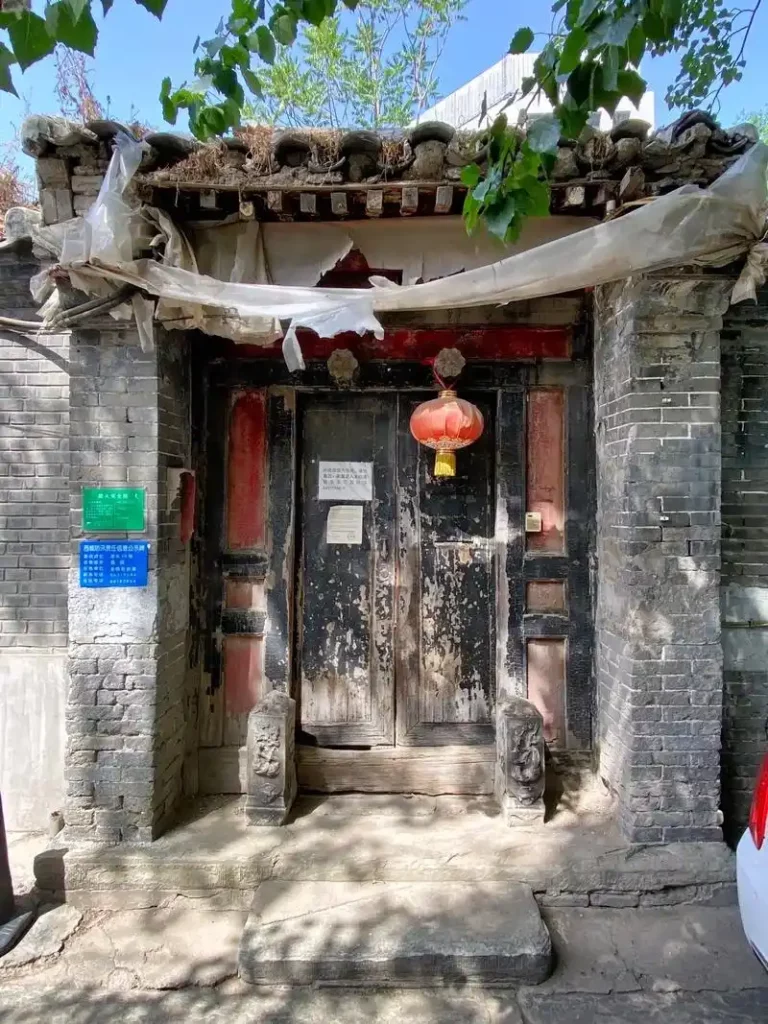
Qi Baishi (1864–1957) was a renowned Chinese artist of modern times, celebrated for his expressive ink wash paintings of flowers and birds. His art exudes vitality and individuality, blending the refined essence of traditional scholar painting with the dynamic charm of folk art. Known as a “People’s Artist,” Qi Baishi’s former residence, located in Kua Che Hutong, Beijing, served as a significant site during his artistic career. Today, this historic home has fallen into disrepair, now a dilapidated structure urgently in need of preservation.
My connection to Qi Baishi’s residence began during an art class, when my teacher took us to visit this old house near our school. As we approached, the silence of time enveloped the place. The once-vibrant gate had faded, its iron lock rusted and hanging heavily in place, a quiet testament to the passage of years. Stepping into the courtyard, we were greeted by decay: the paint on the walls, once bright and vivid, had faded almost entirely, leaving behind only patches of gray. Weeds sprouted through cracks in the walls, as though nature itself was attempting to fill the voids left by neglect. Standing before this crumbling building and witnessing the frustration of my teacher and classmates over its lack of preservation, I paused to reflect: Does preserving ancient buildings mean keeping them in their original form, even if it means allowing them to slowly fall into ruin? Is neglecting their maintenance another form of failure?
These thoughts led me to consider a different approach. Inspired by my computer science class, I asked myself: What if we could preserve these buildings as they are now? Using digital methods, we can meticulously record every detail of ancient structures, preserving their state at a specific moment in time. This approach not only serves as a means to protect cultural heritage but also as a way to “freeze” time itself. Through digitization, the memories of these historic buildings can endure, with their original appearance passed down through generations, keeping their stories alive for the future.